From Services to Evergreen: How Kim Wright Rebuilt Her Business for Freedom
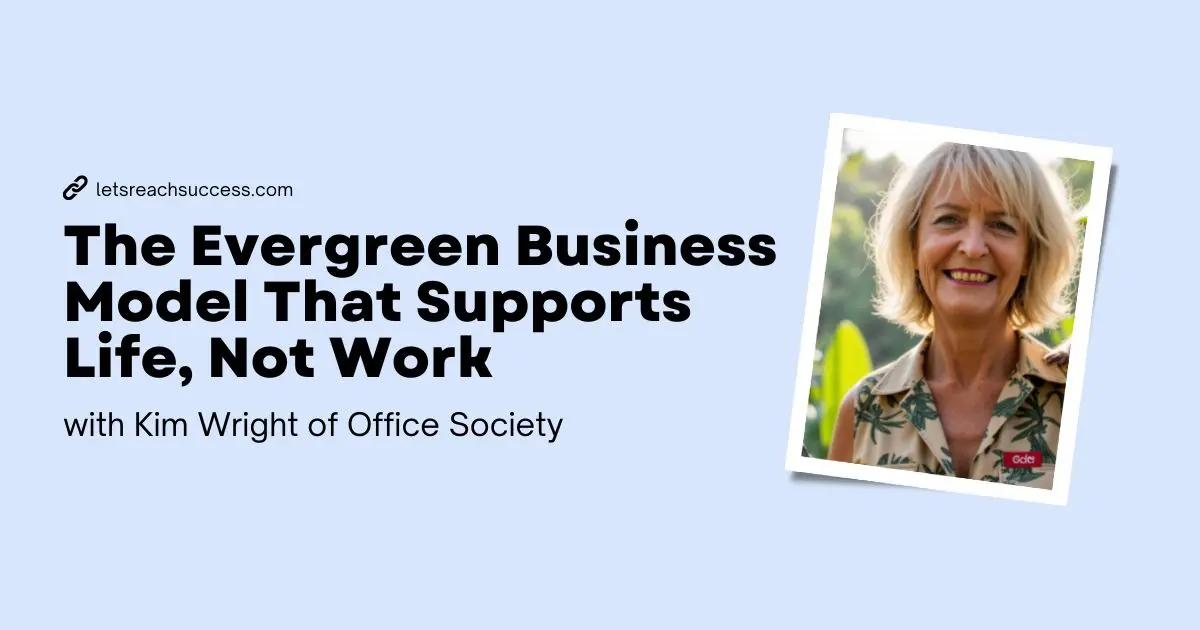
This is an interview with Kim Wright of Office Society.
Hey, Kim. Tell us a bit about yourself and what you do.
Hi, I’m Kim Wright and I call Sydney, Australia home.
I know how overwhelming the digital side of business can be, so I help online business owners declutter their digital workspace and regain control.
Whether it’s organizing files, building simple systems, or using AI without losing the human touch, I help you feel calm, clear, and in control. So your business supports your life, not the other way around.
How did your online business journey begin?
Before starting my business, I spent seven years teaching Administration Skills at a TAFE college in Sydney to school leavers and adult learners. I absolutely loved it. I really believed I had found my calling.
However, changes in government policy meant many of us either lost our roles or, in my case, were left with teaching hours that were no longer sustainable.
Fortunately, I had some time before the changes were fully implemented, which gave me space to think about what might come next. I started keeping a running list of business ideas on my phone.
Everything from bookkeeping and personal assistant services to even designing packaging for cosmetics. There were quite a few ideas on that list, although I no longer have it today.
During that time I was also exploring opportunities in the online business world. Because of my background in administration, the idea of becoming a Virtual Assistant really caught my attention.
However, my first service was actually bookkeeping which also happened to be my very first job when I entered the workforce. I knew there was a shortage of bookkeepers and I already had experience, so it felt like a practical place to start.
My first business was called Kim’s Books. It wasn’t particularly creative, but at that stage I was more focused on getting started than on perfect branding.
Once the changes to my teaching role became certain, I moved quickly and essentially started the business the very next day because I needed to replace my income.
That was in 2017, and it marked the beginning of my online business journey.
Looking back now, my teaching background still influences the work I do today. Especially when it comes to simplifying systems, explaining technology clearly, and helping business owners feel confident using the tools that support their business.
When and why did you start Office Society?
In the early days of my business, I was offering bookkeeping and virtual assistant services, with a strong focus on email marketing.
About six months in, I found myself sitting quietly in my living room asking a bigger question: What do I really want to help people with?
I wanted my work to feel more purposeful and to support business owners in a more holistic way.
So I grabbed a large sheet of butcher’s paper and divided it into three columns. In the first column I listed my skills, in the second my experience, and in the third the things I genuinely loved doing.
As I studied the list, something clicked. I remember the room almost feeling like it went white and I got goosebumps. In that moment I realised I wasn’t really a bookkeeper or a virtual assistant at all. What I’d been doing for years was bringing structure and organisation to the way offices run.
I was, essentially, an Office Manager.
I was so excited that I texted my daughter straight away: “I’ve got it, I’ve got it! I know what I want to do. I can’t wait for you to come home so we can talk about it.”
In January 2018, Office Society was born, with the role of Online Business Manager at its core.
My background had given me a deep appreciation for systems and processes, and I could see a common pattern across the businesses I was working with. Many had complicated workflows, very few had clear systems in place, and their digital files were often chaotic.
I would often be on calls with clients trying to locate files they needed to share with me. The common phrases were things like, “I know I saved it somewhere…” or “I can’t remember what I called it.” Often they would have to send it later because they simply couldn’t find it.
Over time I realised that what many business owners really needed wasn’t just help completing tasks. They needed help creating clear systems, organised files, and workflows that actually made their business easier to run.
My business continued evolving over the years, and in 2024 it shifted again for more personal reasons.
From late 2019 my mother’s health began to decline, and I wanted to be present for both of my parents during that time. For a while I tried to keep my business running while supporting them, but eventually I realised I didn’t want the constant pressure of business sitting in the back of my mind or trying to catch up on work late at night.
So I made the decision to pause my business for a period so I could focus on being there for my family.
When I returned in 2023, I quickly signed three Online Business Manager clients and worked closely with them. But by mid-2024 I found myself feeling burnt out and pulled back again, keeping just one client.
That period gave me the opportunity to rethink how I wanted my business to operate moving forward.
In December 2024 I decided to shift toward a more evergreen business model. One that didn’t rely entirely on me sitting at the computer every day. I wanted to create something that could continue supporting business owners even when life called me elsewhere, while also giving me the freedom to explore other interests.
From that decision, Tame Your Digital Jungle began to take shape in 2025. It replaced my one-to-one OBM work but continues to sit under the Office Society brand.
How long did it take you to make your first money online?
It happened quite quickly.
Within three weeks of starting my business in 2017, I had secured my first two full-time bookkeeping clients. Because bookkeeping had been my very first job when I entered the workforce, I already had the skills and experience, and there was a clear need for that support.
About two months later, I also secured my first full-time virtual assistant client.
From there my client base grew steadily. I worked with a mix of ongoing clients and short-term projects depending on what businesses needed at the time.
Some clients needed help catching up on their bookkeeping and reconciling bank transactions before tax time. Others needed temporary support while they were on holiday or during particularly busy periods.
Alongside bookkeeping, I also began supporting clients with tasks such as social media management and email marketing.
Those early years gave me valuable insight into how online businesses operate behind the scenes and highlighted just how much many business owners were juggling on their own.
Looking back at your first year in business, what did growth look like?
Looking back at my first year in business, growth felt steady and sustainable rather than explosive.
I had a mix of ongoing clients and shorter-term projects. Some businesses needed help catching up on bookkeeping or reconciling transactions before tax time, while others needed temporary support while they were on holidays or during busy periods.
Over time I also expanded the type of work I was doing, including virtual assistant support, email marketing, and some social media management.
While the income didn’t fully replace my teaching salary, it didn’t need to. I had enough clients to feel comfortable and secure, which allowed me to build the business at a pace that suited my lifestyle.
For me, success in that first year wasn’t about rapid growth. It was about creating a stable client base and proving to myself that the business could work.
What services/products do you offer exactly, and who’s your ideal client?
Today my work focuses on helping online business owners simplify and organise their digital workspace.
I offer a mix of short courses, practical workshops, and one-to-one sessions designed to help business owners bring clarity to their files, systems, and digital tools.
My courses focus on areas such as file organisation, simple systems, and using AI in practical ways that still keep the human touch in business.
For those who prefer hands-on support, I also run live one-to-one digital decluttering sessions where we work together to organise spaces like Google Drive, Downloads folders, or desktop files. These sessions are designed to create immediate results so clients leave with a workspace that actually feels manageable again.
My ideal clients are online solo business owners who are managing client work, digital downloads, and growing libraries of files and assets. Over time, those digital spaces can become messy and overwhelming, which makes it harder to find what they need and stay focused.
I help them create simple structures and habits so their digital environment supports their business rather than slowing them down. By the end of our work together, they usually feel lighter, clearer, and far more in control of their business.
How did you attract your very first clients?
All of my first clients came through networking.
Some were people I met at events and connected with directly, while others were referrals from people in my network who knew the kind of work I was offering.
Personally, I’ve always found networking to be the easiest and most natural way to build a client base when you’re offering services. When people understand what you do and trust you, referrals tend to follow.
I never felt the need to chase dozens of clients or build a large team. My goal was simply to work with a small group of businesses where I could make a meaningful difference and build long-term relationships.
How do new clients/students typically discover you today?
Today, most new clients and students discover me through collaborations, partnerships, and my email list.
As my business has evolved away from a service-based model into a more evergreen approach, I’ve intentionally focused on building visibility through summits, bundles, and collaborative events. These have been a powerful way to connect with new audiences who are already looking for support in simplifying their business.
Once someone joins my world, my email list becomes the primary way I nurture that relationship and introduce them to my work.
Referrals still happen from time to time, but my growth now is much more driven by strategic partnerships and audience building rather than one-to-one networking.
How have you grown your email list?
Growing my email list became a priority when I transitioned away from one-to-one services and started building a more evergreen business model.
Previously, my client base grew through networking and referrals, which worked well for service-based work. But I knew that to support a scalable model, I needed to build a community and have an audience I could consistently connect with.
I’ve grown my list primarily through hosting and participating in summits and bundles.
I’ve hosted events such as the Dynamic Systems Summit and the From Stressed to Strategic Summit, and I’ve also contributed to a range of collaborative events including the Simplifying Business Summit, June Jump Start Summit, Aligned AF Black Friday Bundle, and Ultimate Bundles’ Genius Blogger’s Toolkit.
These collaborations have allowed me to connect with aligned audiences while providing valuable, practical content.
This year, I’ve continued to build my list with a stronger focus on strategic partnerships and collaborations, which has been both effective and enjoyable.
This approach has allowed me to steadily grow a highly engaged list.
What email marketing provider are you using and why?
I use MailerLite and have been using it for over seven years.
I chose it initially because it was simple and accessible, and that’s something I still really value today. Like any new technology, there was a learning curve in the beginning, but that was more about how I was approaching it than the platform itself.
At first, I was trying to make it do things it wasn’t designed for. Overcomplicating layouts and formatting. Once I simplified my approach and focused on what actually mattered, it became much easier and more efficient to use.
That experience really aligns with how I approach digital tools in general. The simpler the system, the more likely it is to be used consistently.
How often do you email your list, and what do you include in your newsletter?
I send a weekly newsletter and have been doing so consistently since January 2025.
My newsletter is structured into five core sections, including things like a Topic of the Week, Tip of the Week, and a Product Spotlight. Each section has its own visual style, which makes it easy for readers to skim and quickly find the parts they’re most interested in.
This format works really well for me because it allows me to share ideas in more depth while still keeping the content clear and easy to navigate.
It also reflects my personality and the way I like to communicate. Practical, structured, and focused on helping people take simple, actionable steps to feel more organised and in control of their digital world.
Can you walk us through your content strategy?
My content strategy has evolved significantly over time, especially after I made the decision to step away from social media.
For a long time, I was creating content consistently. Live videos, running Facebook groups, posting regularly, and engaging in other communities.
But when I took a step back and audited how I was spending my time, I realised that a significant portion of my week was going into content that wasn’t delivering meaningful results.
Seeing the actual numbers made the decision clear. I chose to stop focusing on social media and instead go all in on email marketing and community building.
Now, my content strategy is centred around my email list.
I plan my content quarterly, mapping it around what I’m promoting. Whether that’s my own offers or collaborations like summits and bundles. Then I break that down further and write my newsletters month by month, which helps me stay flexible while still working within a clear plan.
My weekly newsletter is structured into five core sections, which makes the content creation process much simpler. It gives me a framework to work within and makes it easier to stay consistent without overthinking what to write.
I also let my audience guide my content. I regularly use polls, surveys, and replies to my emails to understand what my readers need support with. The questions they ask and the challenges they share often shape future content, offers, and promotions.
This approach allows me to create content that feels relevant, useful, and aligned with what my audience actually needs. Rather than creating content just to stay visible.
How much are you currently earning from your business?
At the moment, my business is very much in a growth and refinement phase.
While I have made consistent sales and I do see results each time I make an offer to my email list, I’m still actively testing and refining what works best within my new business model.
My current income streams come from a combination of workshops, one-to-one digital decluttering sessions, and short courses, all centred around helping business owners simplify their digital workspace and systems.
Rather than focusing on exact percentages or rapid scaling, my priority right now is building something that is sustainable, consistent, and aligned with how I want to work as a solopreneur.
I’m not aiming for a high-volume business with hundreds of clients. Instead, I’m intentionally creating a model that provides regular income while also being manageable from both a time and energy perspective.
For me, success isn’t just about revenue. It’s about building a business that supports my life, allows flexibility when I need it, and continues to evolve in a way that feels both practical and enjoyable.
What other ways to grow your brand have worked for you?
For me, the most effective ways to grow my brand have been through collaborations and partnerships, particularly summits and bundles.
I’ve both hosted and contributed to a range of events, including summits and collaborative bundles, which has allowed me to connect with new audiences in a way that feels natural and aligned.
What I like about this approach is that it’s simple and focused. Instead of trying to be visible everywhere, I can show up in spaces where people are already engaged and looking for support.
It also allows me to build relationships with other business owners, which often leads to ongoing opportunities beyond the initial collaboration.
How do you use AI tools in your business?
I use AI tools in a very practical way to support how I think, plan, and create content. Without replacing the human side of my business.
The main tools I use are ChatGPT, Gemini, and Gamma, each supporting different parts of my workflow.
Within ChatGPT, I’ve created a small team of custom GPTs that I use regularly. These include tools like my Jungle Strategist, Newsletter Writing Assistant, Conversion Copy Sidekick, and Audience Growth Plan Builder.
Each one supports a specific part of my business. For example, my Newsletter Writing Assistant helps me structure and refine my weekly emails, while the Jungle Strategist helps me think through ideas and simplify my approach when things start to feel overwhelming.
I also use Projects to keep my chats organised. This has made a big difference in reducing digital clutter and makes it much easier to find conversations and pick up where I left off without scrolling through a long history.
What are your favorite ways to automate admin tasks?
My approach to automation is quite simple. I focus on reducing complexity first, and then using tools to support what’s already working.
One of the most effective ways I “automate” admin tasks is through structured templates and repeatable systems.
For example, my weekly newsletter follows a consistent format, and I use simple folder structures and naming conventions across my business. This removes a lot of decision-making and makes everyday tasks much faster.
I also use email as a central system, planning content quarterly and creating workflows that are easy to maintain rather than overly automated.
AI tools play a supporting role as well. I use tools like ChatGPT to help with structuring content, refining ideas, and speeding up writing tasks. But always in a way that keeps the final output human and aligned with my voice.
What are your top 3 tips for business owners who want to simplify their business?
The first thing I would say is something a little direct… but important:
If nothing changes, nothing changes.
1. Decide that you want things to be different.
Simplifying your business starts with a genuine decision to do things differently.
Many business owners are tired of overcomplicated processes, too many tools, and systems that feel harder to manage than the work itself.
But unless you actively choose to step away from that and try a simpler approach, nothing will shift.
It’s about recognising that just because something has more features or looks more advanced doesn’t mean it’s better for you.
2. Understand that simplicity takes effort upfront.
There’s no real shortcut here. Simplifying your systems does take time and intention.
But once it’s done, the payoff is significant. You save time, reduce frustration, and create space to focus on the parts of your business you actually enjoy.
It’s often the difference between constantly feeling behind and finally feeling back in control. And in many cases, even enjoying your business again.
3. Get support (it doesn’t have to be all or nothing).
You don’t have to figure everything out on your own.
Sometimes a single session, a short course, or a bit of guidance is enough to help you see where to start and what to focus on first.
From there, you can decide how much support you need. It doesn’t have to be a big commitment. Just having someone help you simplify the first step can make everything else feel much more manageable.
What’s your long-term vision for your business?
My long-term vision is to continue building a business that is both sustainable and simple to run.
Over the years, my definition of success has shifted. It’s no longer about doing more or growing for the sake of it. It’s about creating a business that provides consistent income while also allowing me the flexibility to step away when needed and focus on other areas of my life.
That’s what has led me to move toward an evergreen model.
Through Tame Your Digital Jungle, I’m building a collection of courses, workshops, and resources that help business owners simplify their digital workspace. In a way that’s practical and easy to maintain. Without needing constant hands-on support from me.
I want to support more people, but in a way that doesn’t rely on me being at my computer all day.
At the same time, I’ll continue to create content, build my email community, and collaborate with others in aligned spaces.
Ultimately, my goal is to create a business that feels calm, intentional, and sustainable. And to help other business owners experience that same sense of clarity and control in their own business.
Because at the end of the day, a business should support your life. Not take it over.